renderbox-motion · rust · cpu
Motion graphics, written in code.
You write an animation in TypeScript. The engine draws every frame on the CPU, with no browser, no GPU and no screen. This page shows what it can do today.
Everyframe makes its animations with this API.
The engine
An animation is a program. The engine draws it.
- language
- TypeScript
An animation is a tree of text, shapes and footage. Key tracks say how each one moves. There is no timeline to drag.
- rendering
- the CPU
A Rust binary draws every frame. It needs no browser, no GPU and no screen.
- determinism
- 230 hashed cases
One document gives identical frames on every machine in one hash class. The classes are fused (NEON, AVX2) and unfused (scalar, SSE4.2, simd128). Each case is hashed at every SIMD level and compared with a stored hash.
- performance
- 6.31 s
540 frames at 1080 × 1920, run as a real job on a shared render host. A heavier piece of the same size took 22.72 s.
On the fleet since 28 October 2026: the CPU hosts run renderer epoch 2. The GPU hosts come later.
import { Parallel, Rectangle, Text, counter, linearGradient, tint }
  from "@jtdigital/renderbox-sdk/motion";

// one row a city: the bar grows year by year on an eased key track,
// its value rides the bar's end, the row moves to its rank on another
Parallel(
  Text(city.name, { style: t.type.name })
    .anchor("right").place({ x: RACE.nameW, y: barH / 2 }),
  Rectangle({
    w: overYears(i, (y) => width(y, i)), h: barH, radius: 8,
    fill: linearGradient("to right", [tint(SERIES[i], 0.55), SERIES[i]]),
  }).pivot("left").place({ x: RACE.barX, y: 0 }),
  Text(
    counter(overYears(i, (y) => city.values[y]), FIG),
    { style: t.type.value },
  ).anchor("left").place({ x: RACE.barX + 16, y: barH / 2 })
    .move(overYears(i, (y) => width(y, i))),
).move(0, slots(i)).shutter("film");
The race this code draws. Every number and name comes from the program's props, so another sheet of rows makes another dataset in the same layout.
drawn by renderbox-motion
Made with it
Everyframe
Everyframe makes its animations with this API and renderer.
Everyframe's assistant writes each animation as code with this API. Renderbox renders it. Everyframe makes 11 of its 16 example animations today, through FFmpeg. The other 5 need the new renderer, and Everyframe has not switched to it yet. The rest of this page shows the whole engine. Everyframe uses part of it.
- Exact text and numbers
- Text and numbers come out exactly as typed.
- Checked
- Text too small to read on a phone stops the build.
- Every size and language
- One animation makes all of them. Example: 9 ads from one brief.
- No AI generation
- No image or video model is used, so there is no generation cost.
- Same frames every time
- The new renderer draws the same frames on every machine of the same CPU type.
Animation
Any number can move by a rule.
Keys, springs, waves, seeded noise and lag work on any number: a position, a turn, an opacity, a width. Rules add and nest, and one rule can drive many values.
A rule is data in the document, so any frame can be drawn on its own, with nothing to simulate first.
Sixteen rules on one board
Each tile moves a block by one rule and is labelled with the call that moves it.
90 frames at 1920 × 1080, rendered in 0.5 s on an Apple M1 Pro
drawn by renderbox-motion
Title storm
Each letter flies in on its own arc and lands on a beat.
along() · motion blur · beat sync
rendered through FFmpeg
Type
Each word lands on the frame it is spoken.
Captions are set from a transcript, one word at a time. This clip shows the same words in five styles: highlight, pop, bounce, karaoke and typewriter.
The SDK measures text with the renderer's own shaper, so what it lays out is what gets drawn.
Five caption styles
One talking clip five times, captioned by one transcript, so one frame shows how each style lights the same word.
390 frames at 1920 × 1080, five video layers, rendered in 10.5 s on an Apple M1 Pro
drawn by renderbox-motion
Type festival
Words pop in, turned and scaled. A counter runs to 48. The city's name is set in a gradient.
kinetic type · strokes · glow · motion blur
drawn by renderbox-motion
Talking reel
The music dips under the voice. Each word lights up as it is said.
ducking · word-level captions
rendered through FFmpeg
Data
Charts are drawn from the numbers you give them.
Lines, areas, bars, donuts, scatter plots, heatmaps and radars, each drawn on. The numbers and labels come from the program's props, so another sheet of rows makes another video in the same layout.
Ten charts
Ten chart types, then a dashboard that wipes from the dark palette to the light one. Every figure in it is invented, and its footer says so.
29.8 s · 1920 × 1080 · transitions between scenes
drawn by renderbox-motion
Live board
Bars grow and change places as the figures move. The total counts up.
data-driven layers · eased swaps
rendered through FFmpeg
Characters and rigging internal · not in the npm package
Draw a character once. Code moves it.
A character is drawn once, as SVG. A blink, a smile or a crouch is another drawing of the same parts, reshaped. The engine checks the drawings and builds the skeleton from them: which part hangs from which, how far each joint can turn, and which bones make up a limb. It knows six body plans: biped, quadruped, bird, fish, snake and blob.
Verbs move a character on its own clock, and they sum, so a look plays over a breath and a wave. Characters are internal for now, and not in the npm package.
Munch's Big Snack
Two rigged characters in a parallax valley, from dawn to night. Pip takes Munch's cookie and gives it back. Every move is a verb or a block made of verbs, and every sound is cued on their marks. Turn the sound on: the music and effects are CC0, credited in the film.
40.4 s · 1920 × 1080 · 1,212 frames, drawn in 2 min 41 s on an Apple M1 Pro's CPU
Munch is StorySell System's mascot, redrawn for the engine. Pip is the engine's example fox.
The rig
Pip's joints, as the engine reads them
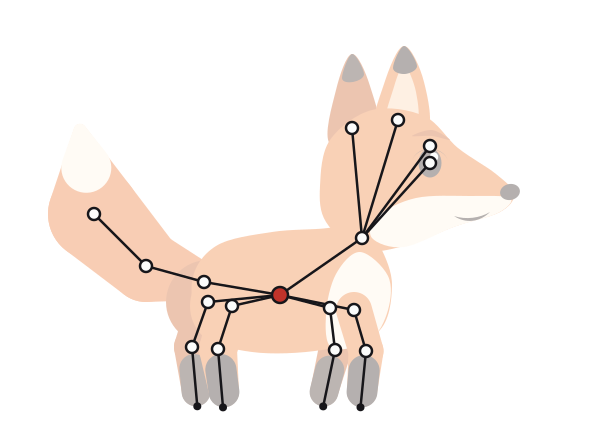
A quadruped of 17 parts. Each leg is two bones, so a reach or a jump plants the paw by inverse kinematics, with the knee bent the way the drawing bends it. The tail is a chain of three.
eight of Munch's fifteen variants
A blob of 17 parts. A variant is the same parts with other numbers, so variants blend point by point. It may also hide or show a paint, or change its colour. Each cell idles and poses once, from rest into its variant and back, and half starving, half thriving is a face nobody drew.
The verbs
Pip idles, greets the title and jumps, three verbs and no key set by hand. The shadow under Pip follows the performance frame by frame, and the title bumps on the frame Pip lands.
- idle
- Breathes, nods after the breath, blinks on a seeded clock and sways the tail and ears, each segment a little after the one before.
- look
- Turns the head and neck within their ranges and moves the pupils inside their eyes.
- pose
- Blends variants by weight and turns joints by angle, and lands exactly on the pose at the second it is given.
- reach
- Puts a paw or a hand on a point by two-bone IK. Out of reach, the limb straightens toward it and never stretches.
- greet
- Follows the body plan: a foreleg waves, a bird flaps, a fish waves a fin, a snake rises and flicks its tongue, a blob hops.
- jump
- Crouch, stretch, flight, squash, settle. The feet stay planted through the crouch, and the ears and tail trail the body.
Footage and effects
Looks, transitions and effects on real footage.
Colour looks, keys, blur, glow, shadows and transitions work on any layer. Footage is decoded frame by frame, so a phone's variable-rate clip plays by each frame's own time.
Sound can drive the edit too: the music dips under a voice, and cuts land on the kicks of a song with no time typed by hand.
Looks and transitions
Eleven colour looks on one shot, a chroma key and fourteen transitions.
20.9 s · grades · keys · shadows and glows
drawn by renderbox-motion
Lens look
A glow, a light leak, a slow push in and a focus pull on one shot.
lens effects over footage
rendered through FFmpeg
Living photo
One photo turned into a slow camera move with depth and haze.
plane cuts · focus pull · grain
rendered through FFmpeg
Trailer cuts
Eight shots joined by a flash, a whip pan, a zoom through and an iris.
custom transitions · frame-exact labels
rendered through FFmpeg
Cut on the drop
Waits for the drop, then cuts on every kick. No time is typed by hand.
audio analysis
rendered through FFmpeg
Formats
One program makes every shape, language and list.
A program names its ratios, languages and rows, and the build makes each one. It also writes video with an alpha channel for an editor to finish.
It reads Lottie files as ordinary values. What it can't draw yet, such as a Lottie's text layers or gradients, is refused by name.
Every shape in one
A 16:9 ad contains its 1:1 version, which contains its 9:16. The last frame leads into the first.
9 s · nested precomps · bit-exact loop
rendered through FFmpeg
Nine ads from one brief
Three languages in three shapes make nine ads, all from one program.
copy fitting · multi-ratio layout
rendered through FFmpeg
Logo stings
Short logo animations from one wordmark outline, plus a version with an alpha channel.
batch generation · alpha output
rendered through FFmpeg
Name cards
A card for every name on a list, each name sized to fit.
per-row glyph check · font fallback
rendered through FFmpeg
A Lottie file, recoloured
A lower third from a Lottie file, recoloured to a theme, its middle held for as long as the name is up.
Lottie import · 4.3 s
drawn by renderbox-motion
Other tools
How other tools draw a frame.
Each of these turns code or a file into video frames. The table shows what you write, what draws each frame, what the tool itself says about drawing the same frame twice, and the licence.
| tool | you write | draws the frame | the same frame twice, as stated | licence |
|---|---|---|---|---|
| HyperFrames | HTML, CSS and JavaScript, timed with data attributes. GSAP, CSS, Lottie, Three.js, Anime.js, WAAPI and TypeGPU animations are seeked frame by frame. | Headless Chrome seeks to each frame and captures it; FFmpeg encodes. Capture uses BeginFrame on Linux and screenshots on macOS and Windows. Chrome's GPU is on for local renders and off in Docker. | “Same input, same frames, same output.” A local render “can shift by a pixel from one machine to the next”; Docker pins Chromium, the fonts and FFmpeg for exact reproducibility. source |
Apache-2.0 |
| Remotion | React components. | Chrome Headless Shell screenshots each frame; Remotion's FFmpeg binary encodes. In headless mode the GPU is off in many cases. Client-side rendering draws a subset of HTML and CSS onto a canvas and encodes with WebCodecs. | It asks it of your components: “A component should always display the same visual when called multiple times.” A full Chrome “may be less deterministic than Chrome Headless Shell”. source |
Remotion License: free for individuals and companies of up to 3 employees, a Company License above that. Selling or relicensing a derivative is barred. |
| Motion Canvas | TypeScript generator functions. | Its editor, in the browser, on the 2D canvas. It exports an image sequence, or video through FFmpeg. | Not stated for frames. Its random values are reproducible. source |
MIT. The last stable release is 3.17.2, December 2024. |
| Revideo | TypeScript generator functions. | Headless Chrome, launched through Puppeteer, draws each frame on a canvas and encodes it with WebCodecs. FFmpeg merges the audio. | Not stated for frames. source |
MIT. Telemetry is on by default; DISABLE_TELEMETRY=true turns it off. |
| Lottie | JSON, usually exported from After Effects with Bodymovin. | A player. lottie-web draws SVG, canvas or HTML in a browser. ThorVG, under dotLottie, draws on the CPU or on OpenGL, WebGL or WebGPU. | The spec makes no claim. LottieFiles, which makes dotLottie, says animations “look identical across all platforms”. source |
Spec 1.0 (September 2024) under the Community Specification License 1.0; its layers are shapes, solids, images, precomps and nulls. lottie-web and ThorVG are MIT. |
| Rive | .riv files with state machines, made in the Rive Editor. Exporting them needs a paid plan. |
The Rive Renderer on the GPU: Metal, Vulkan, Direct3D or OpenGL. On the web, WebGL2 or the browser's Canvas2D. | “State machines are deterministic at fixed steps, which makes playback reproducible across machines and frame rates.” A deterministic mode fixes the random seed for golden-image tests. source |
Runtimes MIT. The editor is not open source. |
| renderbox-motion | The TypeScript composition API, or the CompDoc document it builds. | Rust on the CPU. No browser, no GPU. | The same bytes on every machine in one hash class. 46 draw-model and 184 document cases are hashed at every SIMD level. the engine |
Private. Access by request. |
Each cell is what the tool's own docs, repository or licence say, checked on 2026-10-27. Where a tool says nothing about drawing the same frame twice, the cell says so.
Access is by request.
There is no sign-up. To run work on Renderbox, or to ask how a part of it works, write to us.